
Showing all 4 results
-
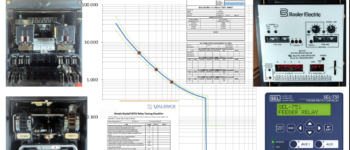
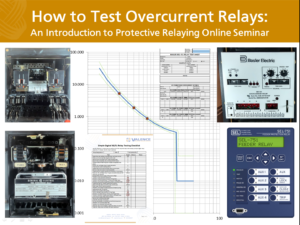
Fundamentals #2: How to Test Overcurrent Relays: An Introduction to Protective Relaying Online Seminar (32 NETA CTDs)
$499.95 USD
Are you new to relay testing? Do you want to create a solid foundation before you get thrown to the wolves?
Have you been thrown to the wolves already and don’t feel confident in your relay testing skills?
If so, this seminar covers the basics of overcurrent protection that new relay testers should know before they start testing relays. It also fills in gaps for self-taught relay testers who had to figure it out for themselves. No matter which situation you are in, if you want to truly understand how to test all overcurrent relays from any manufacturer with any test-set, this is the training you’ve been looking for. We’ve created over 30 hours of short videos that show you how to test any overcurrent relay from any relay manufacturer with your test-set.
Get your questions answered inside these lessons:
- Introduction to Protective Relays
- How to Test Electro-Mechanical Overcurrent Relays
- Understanding Power System Faults
- How to Test Simple Digital Overcurrent Relays
- Introduction to the Power System Studies Used to Create Relay Settings
- How to Test Overcurrent Elements Inside IEDs
This course is eligible for 32 NETA Continuing Technical Development Credits (CTDs). NETA Certified Technicians (Level III and Level IV) are required to earn a minimum of 48 CTDs every three years to maintain their certification. For more information about the CTD program and requirements, please contact the NETA office at neta@netaworld.org or 888-300-6382.
Do you want to enroll more than one person into our online training courses? No problem!
Go to our Team Registration Page at the Valence Training Academy
Click Here To Buy Courses For Multiple Students or Another Person
Click the “Add to cart” Button Below To Purchase This Course For Yourself!
Are you new to relay testing? Do you want to create a solid foundation before you get thrown to the wolves?
Have you been thrown to the wolves already and don’t feel confident in your relay testing skills?
If so, this seminar covers the basics of overcurrent protection that new relay testers should know before they start testing relays. It also fills in gaps for self-taught relay testers who had to figure it out for themselves. No matter which situation you are in, if you want to truly understand how to test all overcurrent relays from any manufacturer with any test-set, this is the training you’ve been looking for. We’ve created over 30 hours of short videos that show you how to test any overcurrent relay from any relay manufacturer with your test-set.
Get your questions answered inside these lessons:
- Introduction to Protective Relays
- How to Test Electro-Mechanical Overcurrent Relays
- Understanding Power System Faults
- How to Test Simple Digital Overcurrent Relays
- Introduction to the Power System Studies Used to Create Relay Settings
- How to Test Overcurrent Elements Inside IEDs
Want More Detail About Individual Lessons?
This seminar starts at the very beginning and defines the basic operating characteristics that you will find in all relays to help you understand why techs test relays the way they do and what failure points you should be looking for inside the relays you test. All overcurrent relays are fed from current transformers (CTs), so we also explain how CTs operate, why a saturated CT is bad, and how you can check to make sure that the CTs are properly installed on the power system.
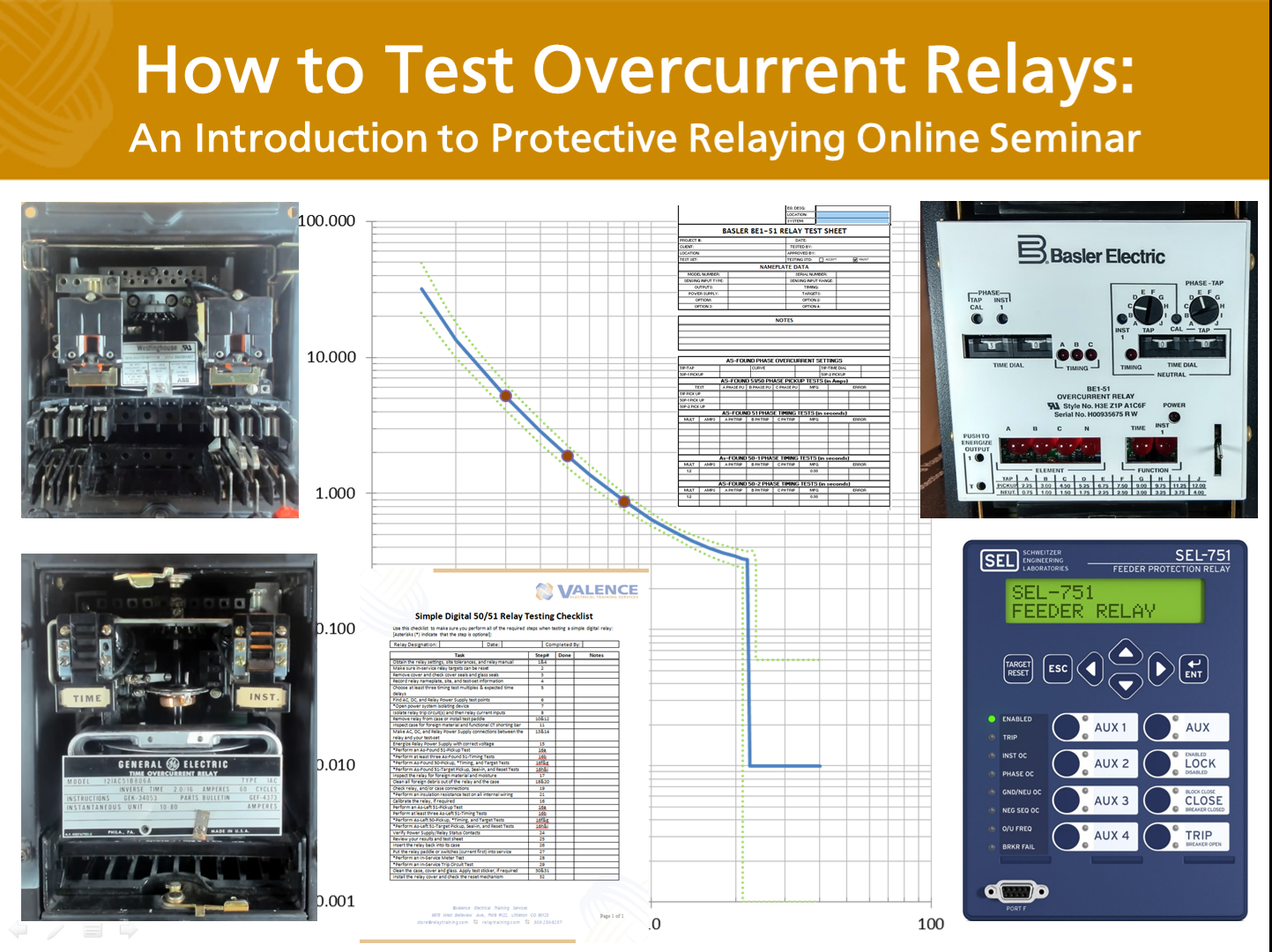
Electro-mechanical relays were the backbone of the power system for over a century and are a great teaching tool because you can see what’s happening inside the relay while you are testing it. Most digital overcurrent relay elements are really just modeling electro-mechanical overcurrent relays, so being able to test and visualize an electro-mechanical relay will help you test any relay. Therefore, the second lesson shows you how to test electro-mechanical overcurrent relays, which sets you up with the basic skills and understanding that you can use for all relay testing.
I thought this was going to be a nice short lesson, but we want to fill in all of the blanks in your relay testing knowledge. That means that we explain every step of the relay testing process. For example; we don’t just don’t tell you to parallel channels when your test-set amplifiers overload, we explain why your amplifiers are overloading and what happens when you parallel channels…and why paralleling too many channels can actually make the problem worse. We spend a lot of time explaining the why of relay testing techniques so that you can apply the correct test procedure when something goes wrong. Then we go through step-by-step procedures with multiple relay and test-set examples that will prepare you to test your relays with your test-sets. You can download test sheets, checklists, and detailed testing instructions that you can use at your site to make sure you are testing your electro-mechanical relays correctly.
The third lesson describes the most common kinds of power system faults so that you can troubleshoot problems after a relay operates…and apply realistic fault simulations with your electro-mechanical relay testing techniques to test any relay with any test-set.
The fourth lesson shows you that the skills you learned in the electro-mechanical lesson can be applied to any relay using a simple digital overcurrent relay (i.e. Basler BE1-51) example. Digital relays have different failure points, so we explain why you need to modify the electro-mechanical test procedures slightly when testing single-function, multi-phase, simple digital relays. Then we show you step-by-step test procedures using multiple test-sets along with test sheets, checklists, and detailed testing instructions that you can download and use at your site.
We strongly believe that if you truly understand the theory of a topic, you will be a better relay tester. The fifth lesson gives you a peak behind the curtain and shows you how a relay engineer uses engineering studies to create relay settings, which will help you understand what you are testing and find setting mistakes, which are the most common reasons why relays mis-operate when in-service. We also show you how to search through a coordination study to find the relay settings and create test points that make sure the correct settings have been applied the easy way without needing to decode digital relays settings.
In the final lesson, we discuss why modern relays should really be called intelligent electronic devices (IEDs). These “relays” may share some features with traditional overcurrent relays, but they are much more complicated and have significantly different failure points. Traditional test techniques simply aren’t designed to find the most common problems inside IEDs, but we show you how to take all of the knowledge and techniques learned in this seminar and apply them to IEDs with the updated overcurrent element testing plan described in this lesson. As usual, there are step-by-step test procedures using multiple test-sets along with test sheets, checklists, and detailed testing instructions that you can download and use at your site to test the overcurrent elements inside this seminar.
You can download a course brochure here
How Online Seminars Works
This online seminar contains over 30 hours of videos (usually less than 15 minutes each) that you can watch at your own pace in any order with an internet connection. When you purchase the seminar with your credit card, you will have unlimited, 24/7 access to all the videos with no expiration date. Each video has closed captioning, fast-forward/rewind/play speed controls, and you can revisit the videos whenever you wish.
We try to follow a “show don’t tell” philosophy in all our videos and use realistic conditions as much as possible. This seminar isn’t just a bunch of pre-recorded webinars and power point slide presentations. You will watch the instructor test different relays with different test-sets and explain what he is doing every step of the way. We didn’t cut out the mistakes he made while testing and creating the settings, so you will also see how to troubleshoot problems when they happen.
Continuing Education Credits
You will get a certificate of achievement when you complete all of the topics and lessons in the seminar that you can use for continuing education credits with your organization. Please let us know if you need any help getting accreditation with your organization. We will do the best we can to help you.
This course is eligible for 32 NETA Continuing Technical Development Credits (CTDs). NETA Certified Technicians (Level III and Level IV) are required to earn a minimum of 48 CTDs every three years to maintain their certification. For more information about the CTD program and requirements, please contact the NETA office at neta@netaworld.org or 888-300-6382.
Do you want to enroll more than one person into our online training courses? No problem!
Go to our Team Registration Page at the Valence Training Academy
Click Here To Buy Courses For Multiple Students or Another Person
You control who gets enrolled into the course via the “Manage Teams” page. Enroll one at a time, or upload your entire team via a simple csv file. We’ll automatically create everything they need to start the course and send them an email with their user name, password, and course links.
Click the “Add to cart” Button Below To Purchase This Course For Yourself!
5 reviews for Fundamentals #2: How to Test Overcurrent Relays: An Introduction to Protective Relaying Online Seminar (32 NETA CTDs)
Related products
-

Choose Your Relay Testing Fundamentals Online Training Programs In One Place
All the online theory and practical information we offer at once.
Get instant access to the entire relay testing fundamentals series that will give you the basic knowledge that will allow you to test any element in any relay/IED with any test-set:
- Fundamentals #1: Phasor Drawings for Relay Testers Course (Approx. 4 Hours of Lectures, Lessons, and Quizzes)
- Fundamentals #2: How to Test Overcurrent Relays Online Seminar (Over 32 Hours of Videos)
- Fundamentals #3: How to Test Protective Relays Online Seminar (Over 16 Hours of Videos)
- Fundamentals #4: How to Test Voltage Elements Inside IEDs/Relays (Over 13 Hours of Videos & 16 CEUs)
Fundamentals #1) The Phasor Drawings for Relay Testers Online Course – which helps relay testers understand the building blocks of every relay test, and convert between the FOUR different phase angle systems used in the protection and control (P&C) world. Your test-set and relay probably use two different phase angle systems.
Fundamentals #2) The How to Test Overcurrent Relays: An Introduction to Protective Relaying Online Seminar – which uses electro-mechanical and solid state overcurrent relays to help you understand relays, CTs, and how to apply the four fundamental tests that can be applied to any element inside any relay with any test-set. (Ramping pickup tests, pulsing pickup tests, timing tests, dynamic timing/pickup tests) You also learn how to perform the electrical and mechanical tests on an electro-mechanical relay.
Fundamentals #3) The How to Test Protective Relays/IEDs Online Seminar – which shows you what you should be testing inside an IED/Relay (Hint: standard element testing won’t find the most common problems) and how to apply those four fundamental tests to modern digital IEDs/Relays…without changing settings! This seminar will help you:- understand why you are testing,
- what you should be testing,
- learn how to get green checkmarks on your test report that actually matter, and
- how to troubleshoot problems.
Fundamentals #4) The How to Test Voltage Protection in IEDS/Relays Online Training Seminar – which shows you how to connect, understand, and test Over- and Under-Voltage elements in IEDs/Relays with Wye, Open-Delta, and Broken Delta connections. This seminar also sets you up to test more advanced element tests with detailed information about three-phase, phase-to-phase, and phase-to-ground faults and symmetrical components.
Do you want to enroll more than one person into our online training courses? No problem!
Go to our Team Registration Page at the Valence Training Academy
Click Here To Buy Courses For Multiple Students or Another Person
Do you want to purchase courses for yourself?
Make your selections below and click “Add to cart”
-
Fundamentals #3: How to Test Protective IEDs (Relays) Online Seminar (16 NETA CTDs)
This online protective relay testing seminar follows Chris Werstiuk (author of The Relay Testing Handbook) as he shows you the basic skills you need to test any digital relay with any modern test-set. Learn how to test protective relays with online videos that are broken down into logical chunks that you can watch at any time and in any order so that you can fit this series into your busy schedule.
Sign up today and earn 16 NETA CTDs!
Do you want to enroll more than one person into our online training courses? No problem!
Go to our Team Registration Page at the Valence Training Academy
Click Here To Buy Courses For Multiple Students or Another Person
Click the “Add to cart” Button Below To Purchase This Course For Yourself!
-

Fundamentals #4: How to Test Voltage Elements Inside IEDs/Relays (16 NETA CTDs)
The How to Test Voltage Protection in IEDS/Relays Online Training Seminar is the last seminar in our Relay Testing Fundamentals Online Training program– which shows you how to connect, understand, and test Over- and Under-Voltage elements in IEDs/Relays with Wye, Open-Delta, and Wye/Broken Delta connections. This seminar also sets you up to test more advanced element tests with detailed information about three-phase, phase-to-phase, and phase-to-ground faults and symmetrical components.
This new seminar has the following lessons:
- Lesson 1: Introduction to Voltage Transformers (PTs or VTs)
- Lesson 2: How to Test OverVoltage (59-Element) Protection Inside an IED/Relay
- Lesson 3: Symmetrical Components for Relay Testers
- Lesson 4: How to Test UnderVoltage Elements (27)
- Lesson 5: How to Test IEDs/Relays With Delta PT Connections
- Lesson 6: How to Test IEDs/Relays With Wye/Broken-Delta VT Connections
This course is eligible for 16 NETA Continuing Technical Development Credits (CTDs). NETA Certified Technicians (Level III and Level IV) are required to earn a minimum of 48 CTDs every three years to maintain their certification. For more information about the CTD program and requirements, please contact the NETA office at neta@netaworld.org or 888-300-6382.
-

Fundamentals #1: Phasor Drawings for Relay Testers Course (4 NETA CTDs)
Waveform diagrams contain every detail of an electrical system, but that information can be difficult to understand without a lot of effort. Phasor drawings take the complex information embedded in waveform drawings and convert it into phasor diagrams so that you can see the most important information about an electrical system at a glance. Understanding phasor drawings is probably one of the most important skills that a relay tester must have to be successful!
Take this course to learn these topics:
Understanding Phasors and Creating Phasor Drawings- What Are Phasors?
- How to Draw Phasor Diagrams
- Drawing Phasors with Different Scales
Create and Understand Phasor Diagrams Used by Different Relay and Test-Set Manufacturers
- Drawing Phasors with Lagging Angles (Megger and GE SR)
- Draw Phasors with Positive Angles (Doble and Manta Test Systems)
- Draw Phasors with Negative Angles (GE UR)
- Draw Phasors with Positive and Negative Angles (Omicron and SEL)
Do you want to enroll more than one person into our online training courses? No problem!
Go to our Team Registration Page at the Valence Training Academy
Click Here To Buy Courses For Multiple Students or Another Person
Click the “Add to cart” Button Below To Purchase This Course For Yourself!
-
Fundamentals #3: How to Test Protective IEDs (Relays) Online Seminar (16 NETA CTDs)
This online protective relay testing seminar follows Chris Werstiuk (author of The Relay Testing Handbook) as he shows you the basic skills you need to test any digital relay with any modern test-set. Learn how to test protective relays with online videos that are broken down into logical chunks that you can watch at any time and in any order so that you can fit this series into your busy schedule.
Sign up today and earn 16 NETA CTDs!
Do you want to enroll more than one person into our online training courses? No problem!
Go to our Team Registration Page at the Valence Training Academy
Click Here To Buy Courses For Multiple Students or Another Person
Click the “Add to cart” Button Below To Purchase This Course For Yourself!
-
Fundamentals #4: How to Test Voltage Elements Inside IEDs/Relays (16 NETA CTDs)
The How to Test Voltage Protection in IEDS/Relays Online Training Seminar is the last seminar in our Relay Testing Fundamentals Online Training program– which shows you how to connect, understand, and test Over- and Under-Voltage elements in IEDs/Relays with Wye, Open-Delta, and Wye/Broken Delta connections. This seminar also sets you up to test more advanced element tests with detailed information about three-phase, phase-to-phase, and phase-to-ground faults and symmetrical components.
This new seminar has the following lessons:
- Lesson 1: Introduction to Voltage Transformers (PTs or VTs)
- Lesson 2: How to Test OverVoltage (59-Element) Protection Inside an IED/Relay
- Lesson 3: Symmetrical Components for Relay Testers
- Lesson 4: How to Test UnderVoltage Elements (27)
- Lesson 5: How to Test IEDs/Relays With Delta PT Connections
- Lesson 6: How to Test IEDs/Relays With Wye/Broken-Delta VT Connections
This course is eligible for 16 NETA Continuing Technical Development Credits (CTDs). NETA Certified Technicians (Level III and Level IV) are required to earn a minimum of 48 CTDs every three years to maintain their certification. For more information about the CTD program and requirements, please contact the NETA office at neta@netaworld.org or 888-300-6382.
-
Fundamentals #1: Phasor Drawings for Relay Testers Course (4 NETA CTDs)
Waveform diagrams contain every detail of an electrical system, but that information can be difficult to understand without a lot of effort. Phasor drawings take the complex information embedded in waveform drawings and convert it into phasor diagrams so that you can see the most important information about an electrical system at a glance. Understanding phasor drawings is probably one of the most important skills that a relay tester must have to be successful!
Take this course to learn these topics:
Understanding Phasors and Creating Phasor Drawings- What Are Phasors?
- How to Draw Phasor Diagrams
- Drawing Phasors with Different Scales
Create and Understand Phasor Diagrams Used by Different Relay and Test-Set Manufacturers
- Drawing Phasors with Lagging Angles (Megger and GE SR)
- Draw Phasors with Positive Angles (Doble and Manta Test Systems)
- Draw Phasors with Negative Angles (GE UR)
- Draw Phasors with Positive and Negative Angles (Omicron and SEL)
Do you want to enroll more than one person into our online training courses? No problem!
Go to our Team Registration Page at the Valence Training Academy
Click Here To Buy Courses For Multiple Students or Another Person
Click the “Add to cart” Button Below To Purchase This Course For Yourself!
Protective Relay Training Class/Course Evaluation Form –
Do it
John AETCO –
Worth the time and money
Protective Relay Training Class/Course Evaluation Form –
Take it, well worth it.
Protective Relay Training Class/Course Evaluation Form –
Wish I took this before I started testing relays
A must for anyone testing relays without formal training. You can only gather so much information from other technicians and reading.
Richard Reardon, PE, EMCC Department Chair of Electrical Programs –
Excellent course with incredible pedagogy. The screen shot for each lesson was well organized with the spreadsheet, test set software, video camera on the relay, relay software, notes, and red outlining. This organization made it very easy for me to follow your narration. Then you broke each topic into less than 15 minute chunks allowing me to absorb the new topic and digest the new information before taking another bite. Very well done.